What is ISELED®?2024-11-18T11:57:58+01:00
  • Hebatronic About ISELED® and ILaS® Solutions Compatible with Arduino IDE

ISELED® and ILaS®

Smart lighting technology for dynamic illumination

With precise real-time color changes, intelligent control, and easy integration, ISELED® sets new standards in lighting technology.

More information can be found at www.iseled.com

Hebatronic ISELED® LED technology logo

Benefits of ISELED®

About ISELED® and ILaS®

How does the ISELED® technology work?

What is ISELED®?

ISELED® is an innovative lighting technology that uses intelligent RGB LED modules to enable dynamic lighting solutions. This technology simplifies design and production through fully integrated calibration and allows for precise real-time control.

01/03

How does ISELED® work?

ISELED® modules are digitally addressable, calibrated RGB LEDs connected via a fast 2 Mbit/s bus system. This allows up to 4079 LEDs to be connected in a chain and controlled individually – without the need for complex calibration processes.

02/03

What is the ILaS® network?

The ILaS® network extends ISELED® by enabling the control of LEDs, sensors, and actuators through a simple two-wire connection. This allows for the efficient integration of complex lighting and sensor systems.

More information can be found here.

03/03

Versatile applications

Innovative lighting technology
that makes a difference in every industry
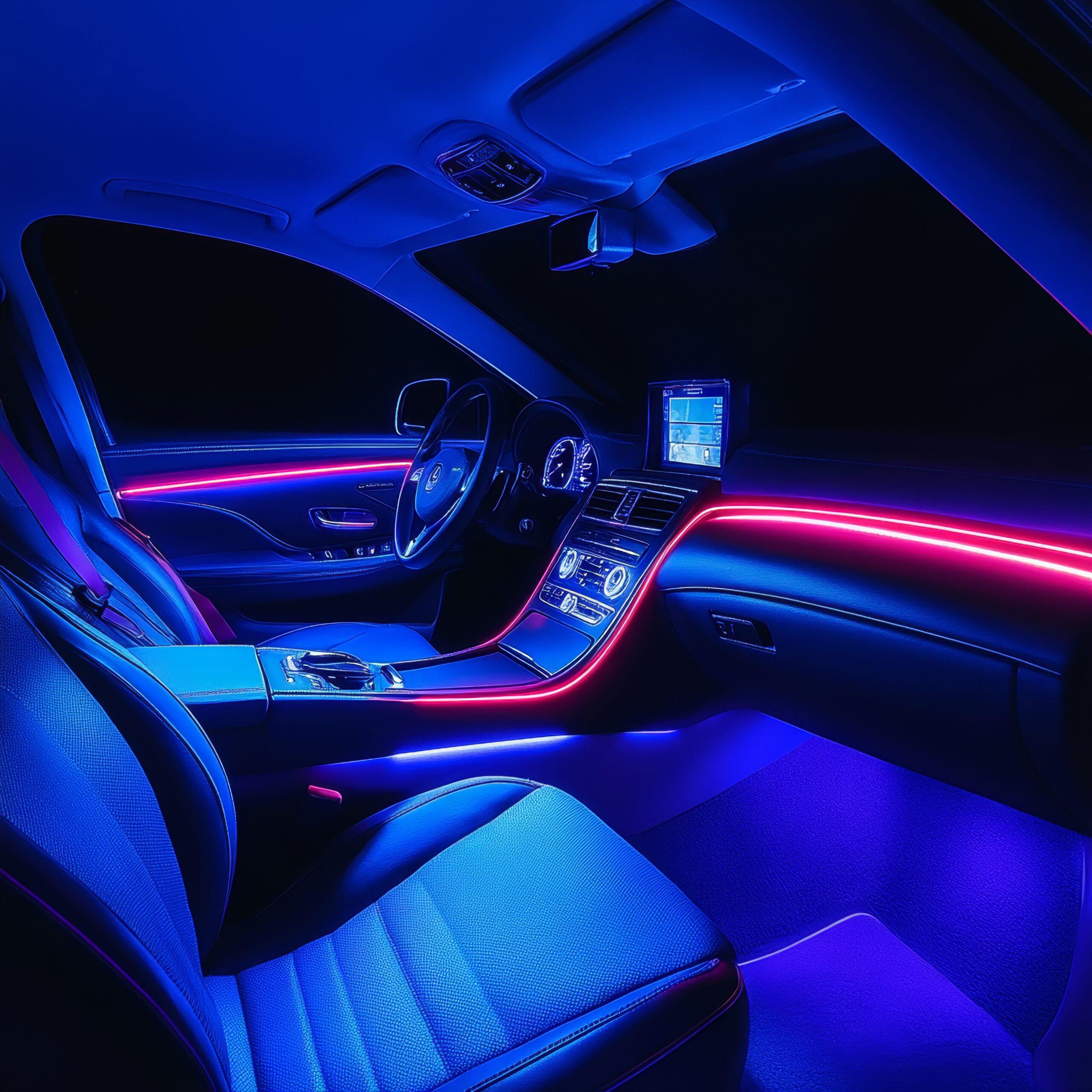
Hebatronic LED lights versatile application automotive car interior light

Automotive Industry

The automotive industry requires the highest standards of precision and safety. Our Arduino-compatible development boards help you achieve this: they are robust, cost-effective, software license-free, and ensure that your development process is optimally equipped. Whether for headlights, interior lighting, or as manufacturing aids in production – we provide solutions that drive the automotive industry forward with reliability and innovation.

Our solutions

The ideal complement to ISELED® technology
for maximum performance

  • Easy programmability
  • Compact design
  • Future-proof
  • Quick integration
  • High flexibility
  • New series

    Hebatronic 3D Connector Series

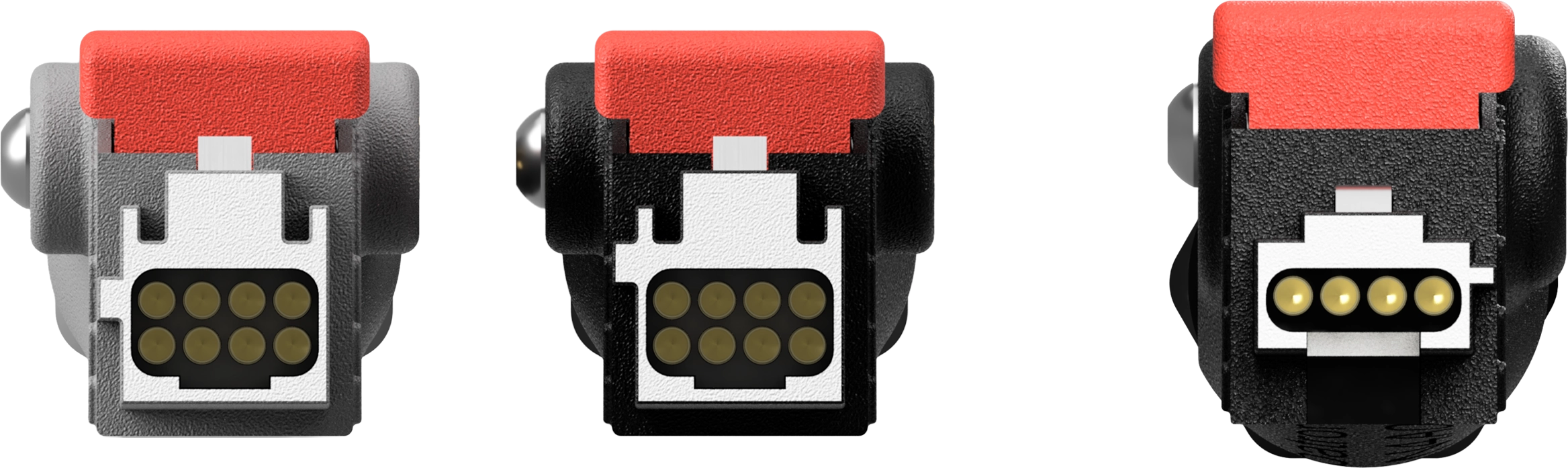
    Precise, robust, and customizable connectors for prototypes, validation, and EoL testing. Hebatronic’s 3D connectors combine mechanical stability with maximum flexibility. They are manufactured using SLS or MJF processes and are optimized for prototypes, test benches, EoL testers, and small series—ideal for applications such as ISELED®, ILaS®, or LED modules.

  • New

    Hebastack – Compact board stack solution for ILaS® & ISELED®
    Hebabox – Automated gateway solution for ILaS® & ISELED®

    Hebastack

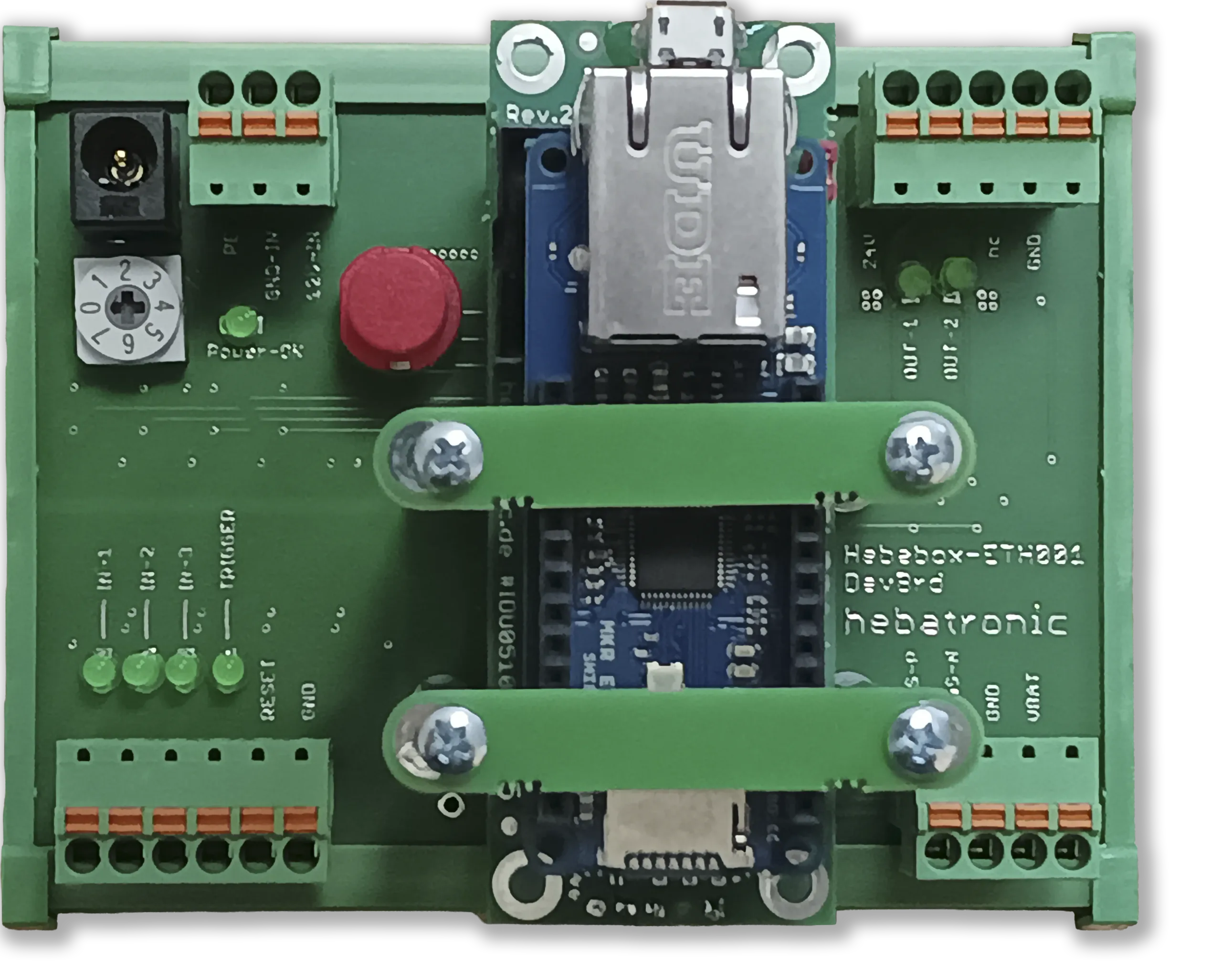
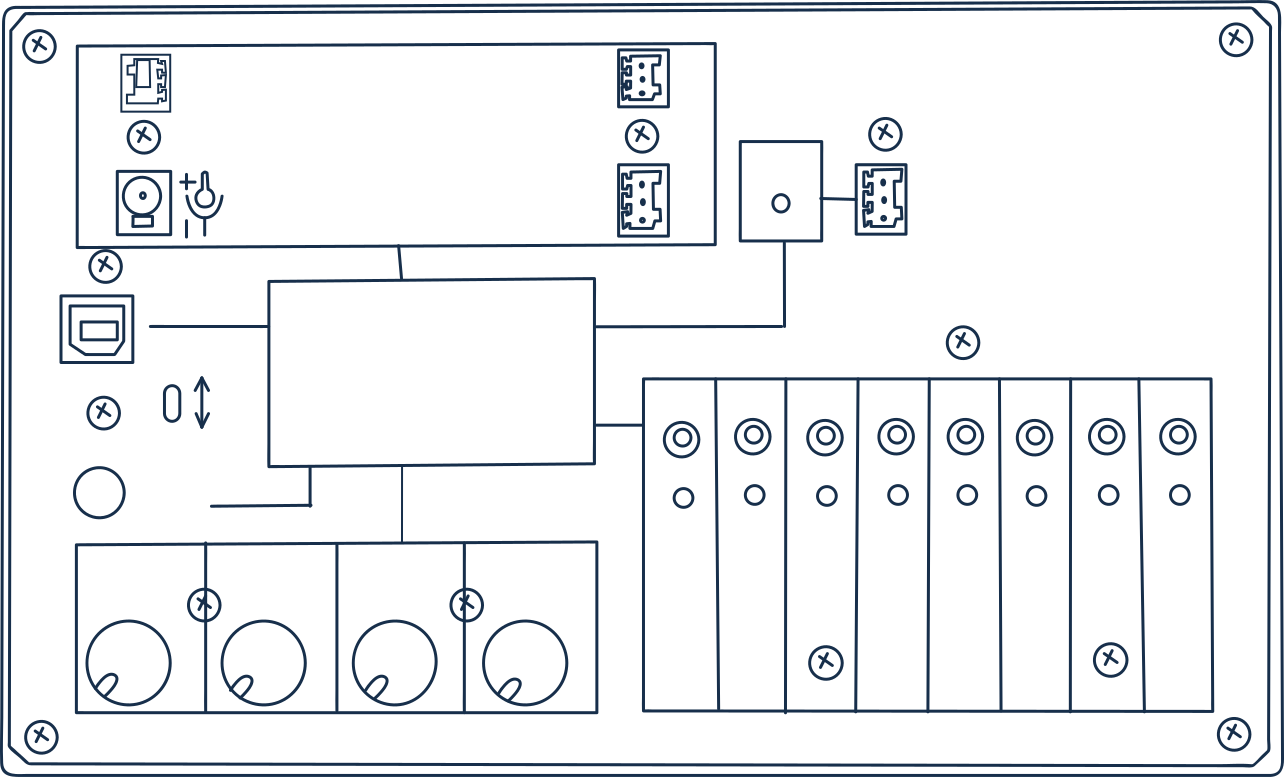
    The Hebastack is the compact board-stack solution for ILaS® and ISELED® systems. Without housing, without power supply, and even more compact than the Hebabox, it is specifically designed for direct integration into control cabinets and EOL test benches. It provides full gateway functionality with Ethernet (Modbus TCP) and digital I/Os – extremely space-saving, flexible, and ideal for automated quality assurance.

  • New

    Hebabox – Automated gateway solution for ILaS® & ISELED®
    Hebabox – Automated gateway solution for ILaS® & ISELED®

    Hebabox

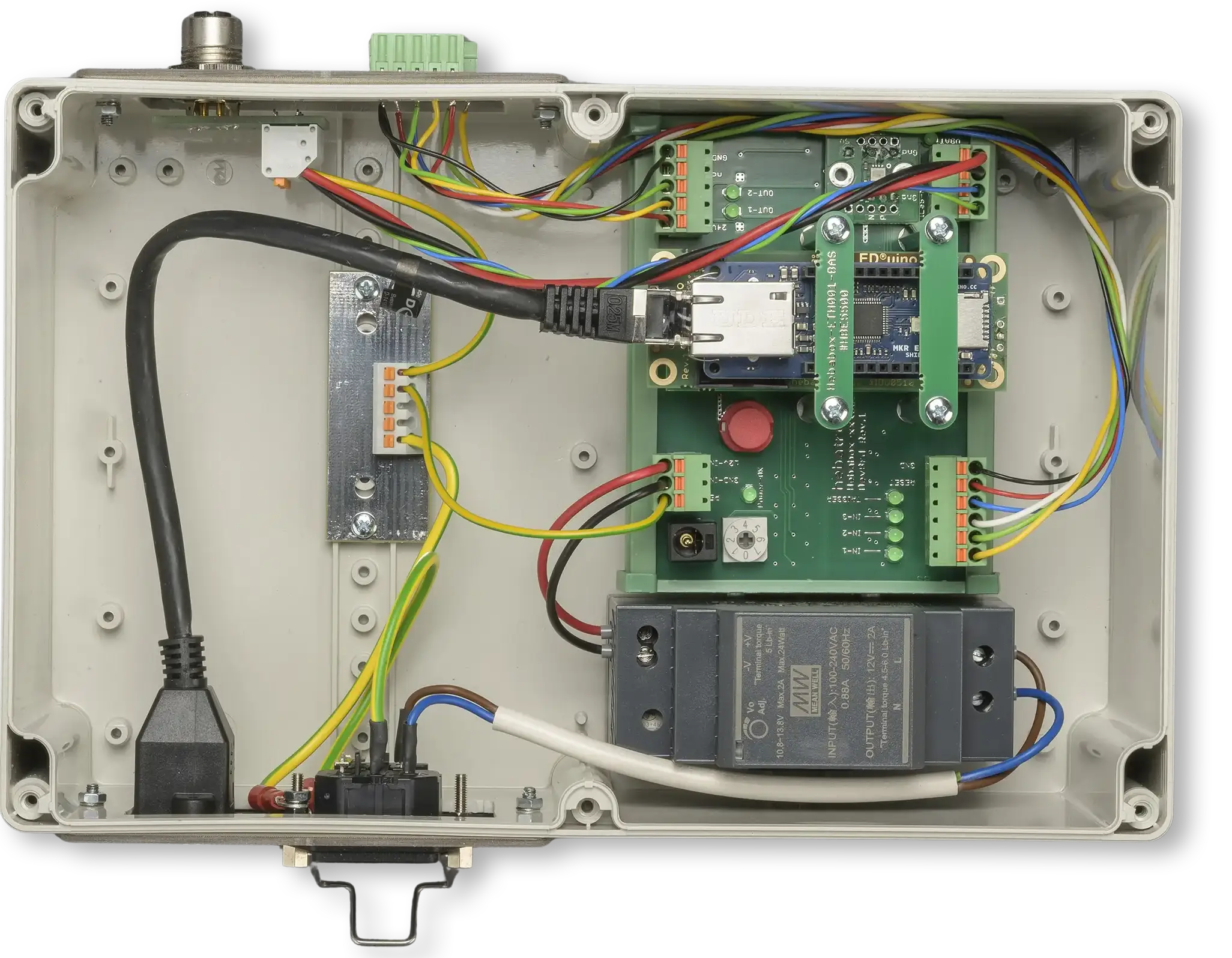
    The Hebabox is the robust housing solution for ILaS® and ISELED® systems. It can be mounted on a DIN rail and is ideally suited for integration into control cabinets and end-of-line test benches. With full gateway functionality via Ethernet (Modbus TCP) and digital I/Os, delivered with the latest Hebatronic firmware, it is compact, flexible, and perfectly tailored for automated quality assurance.

  • Mini

    Hebatronic Produkte ISELED & ILaS Grafik Mini-ILaS-Shield
    Hebatronic Produkte ISELED & ILaS Produktfoto Mini-ILaS-Shield

    Mini-ILaS®-Shield

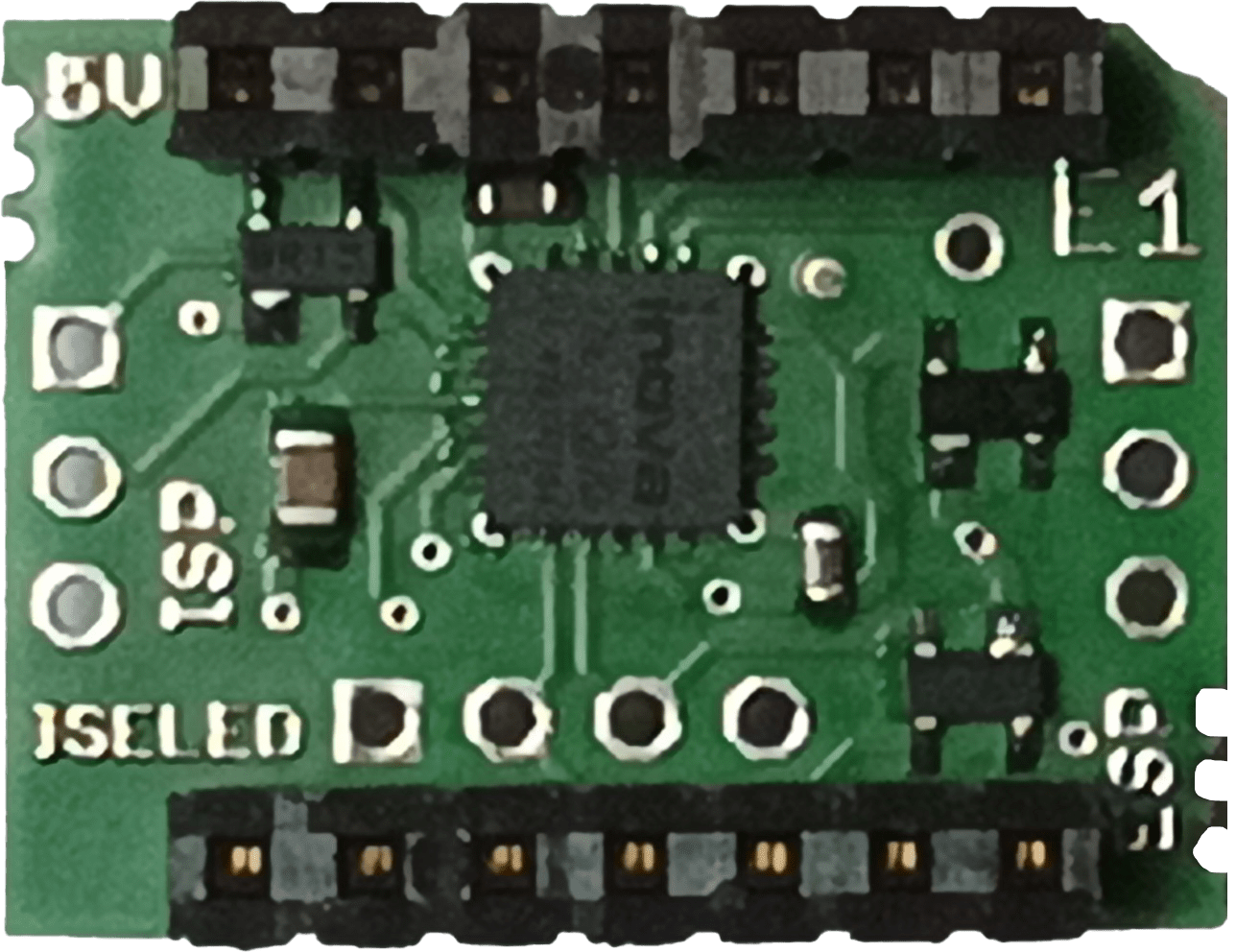
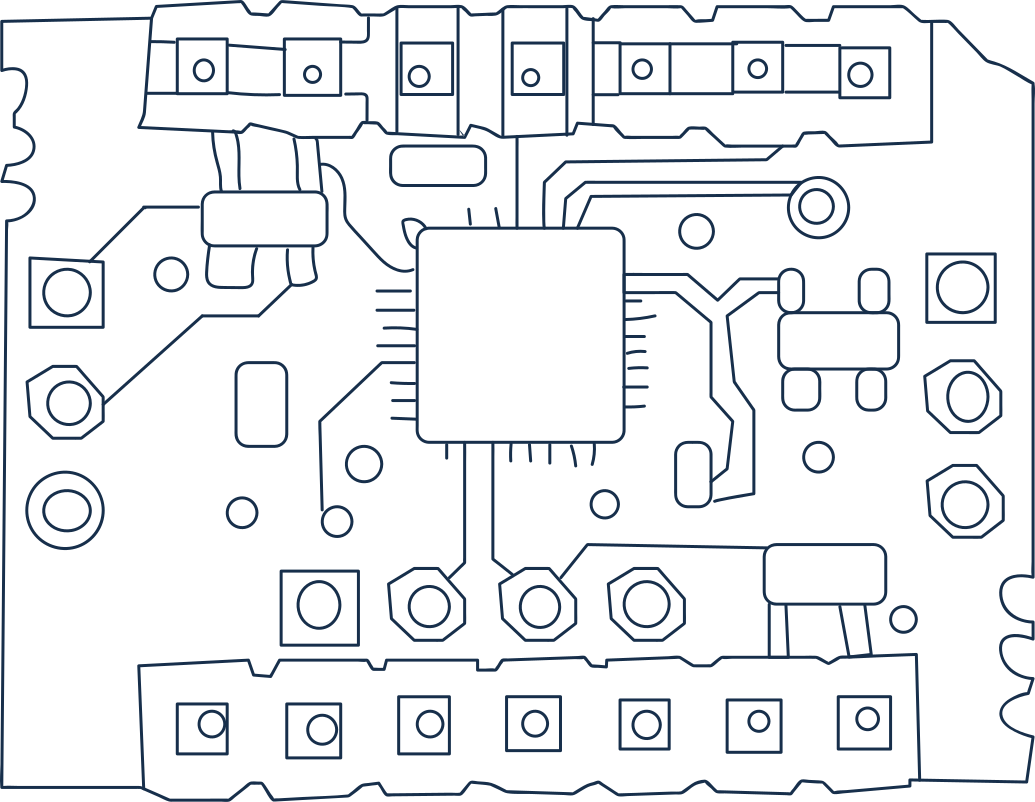
    Miniature interface board (18x24mm) specifically designed to work with the Mini-ISELED®uino, allowing for a very compact system to control ILaS® bus protocol or ISELED® without the need for additional hardware.

  • Mini

    Hebatronic Produkte ISELED & ILaS Grafik Mini-ISELEDuino
    Hebatronic Produkte ISELED & ILaS Produktfoto Mini-ISELEDuino

    Mini-ISELED®uino

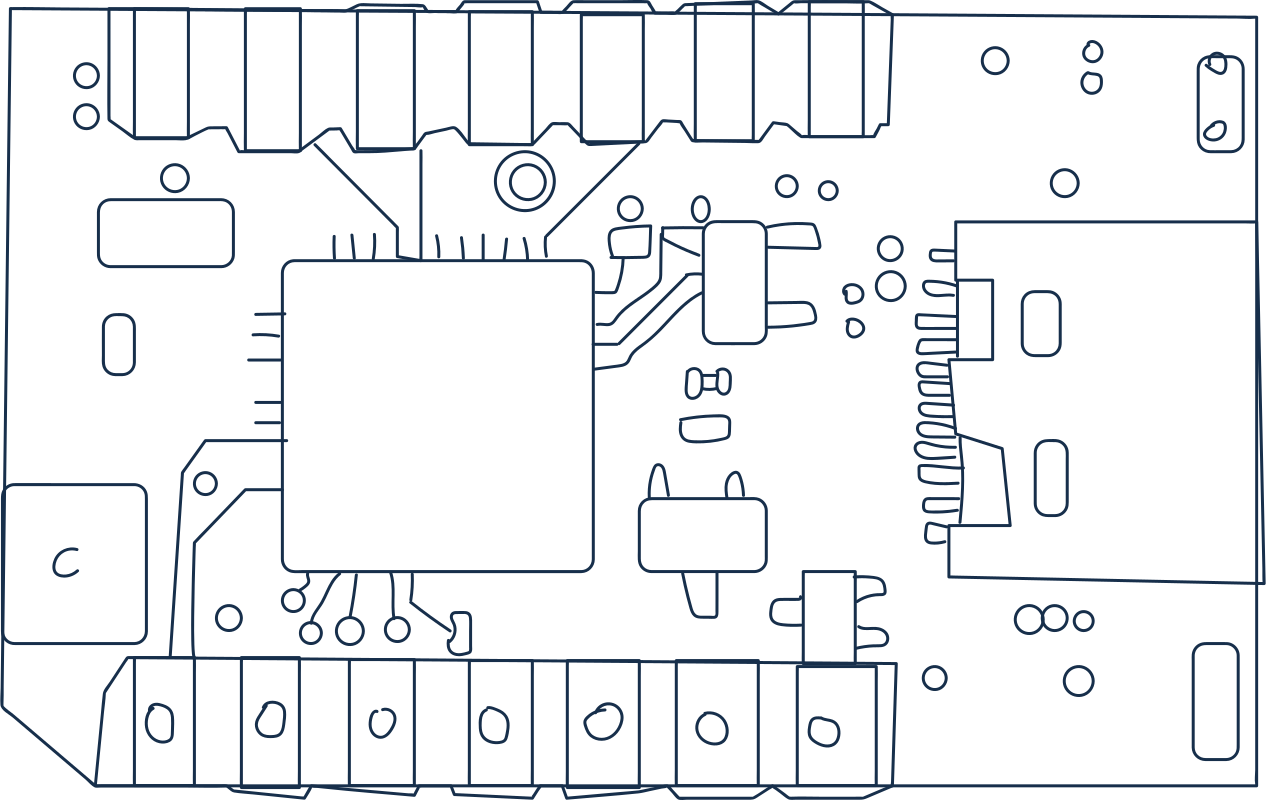
    Miniature controller board (18x29mm) as a base for space-constrained ILaS®/ISELED® applications, enabling quick, tailored solutions through a USB interface.

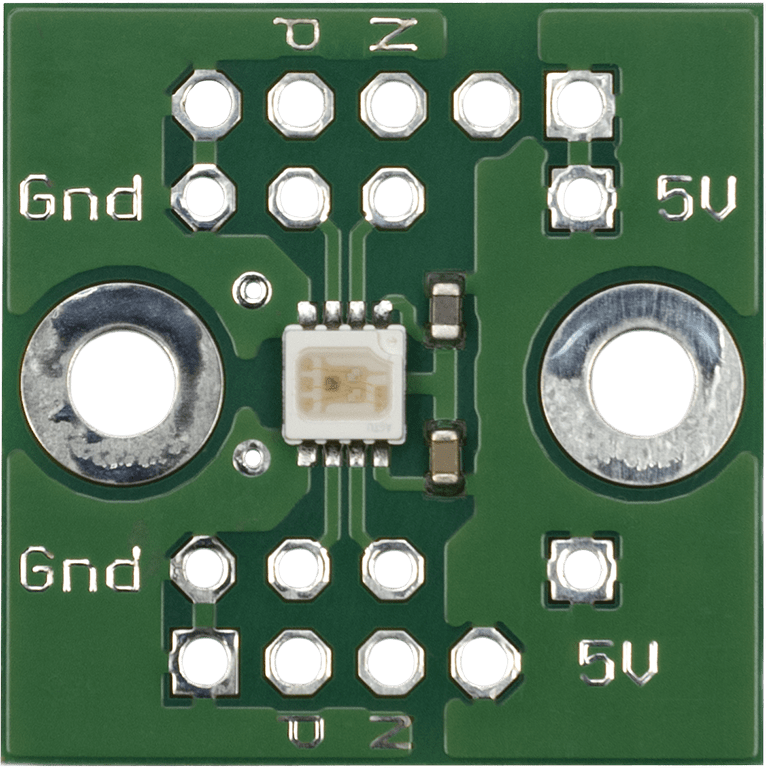
  • Hebatronic Produkte ISELED & ILaS Grafik Diver-LED
    Hebatronic Products ISELED® & ILaS® Diver-LED SmartRGB Board

    Driver-LED

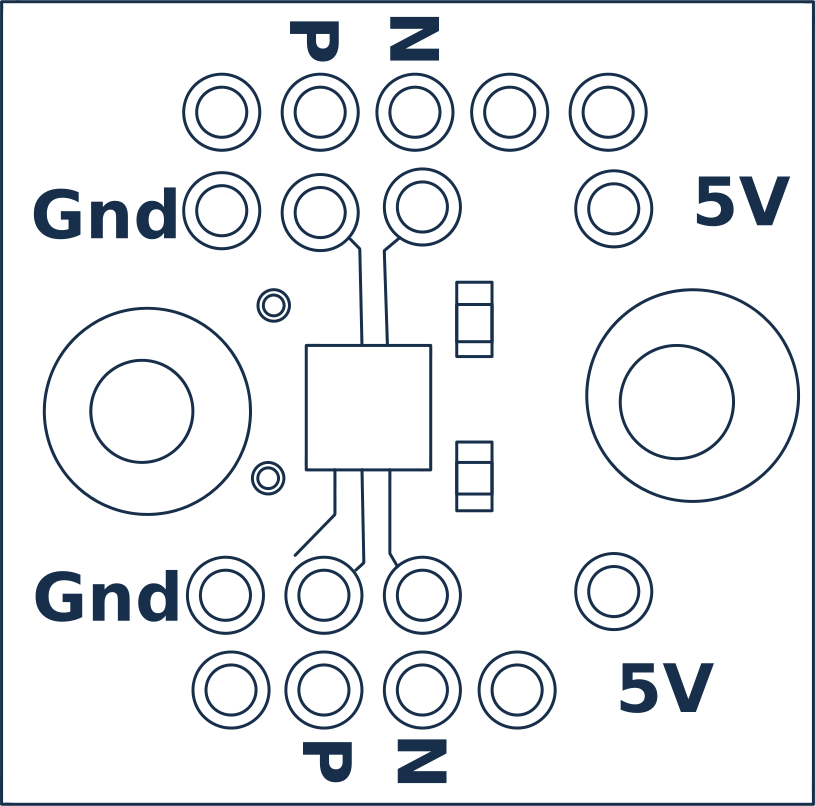
    Single SmartRGB LED (seddLED3.0 from Dominant) on a PCB with solder pads for signal conversion from SPI to differential ISELED signal.

  • All-in-One

    Hebatronic Product ILaS®-Initiator Combined Test Box for ISELED® and ILaS® LED Controllers
    Hebatronic Product ILaS®-Initiator Combined Test Box for ISELED® and ILaS® LED Controllers

    ILaS®-Initiator

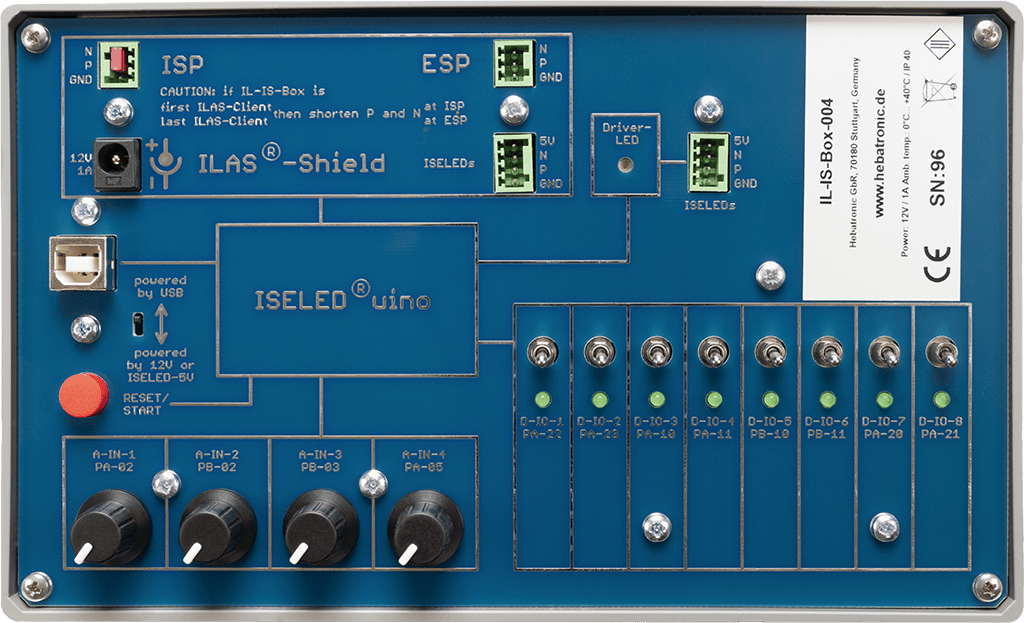
    Combined test box for the development area or as a manufacturing aid to control ISELED® or other modules in the vehicle sensor network – optionally with or without IlaS® communication bus connection.

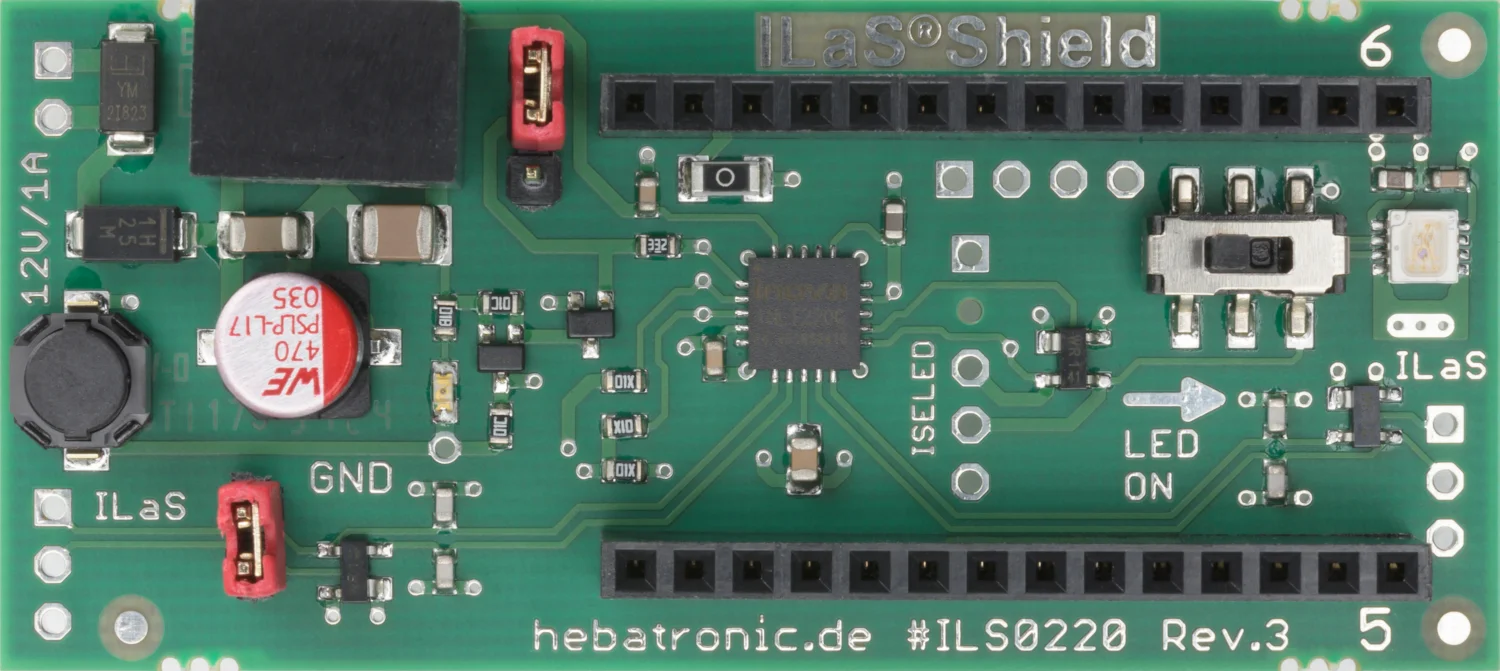
  • Hebatronic Product ILaS®-Shield Arduino Compatible Module for ISELED®uino
    Hebatronic Product ILaS®-Shield Arduino Compatible Module for ISELED®uino

    ILaS®-Shield

    Standalone Arduino-compatible module that can be plugged into the ISELED®uino to activate ILaS® bus protocol capability – powered by the new E4 transmitter-receiver microchip with integrated power-saving mode.

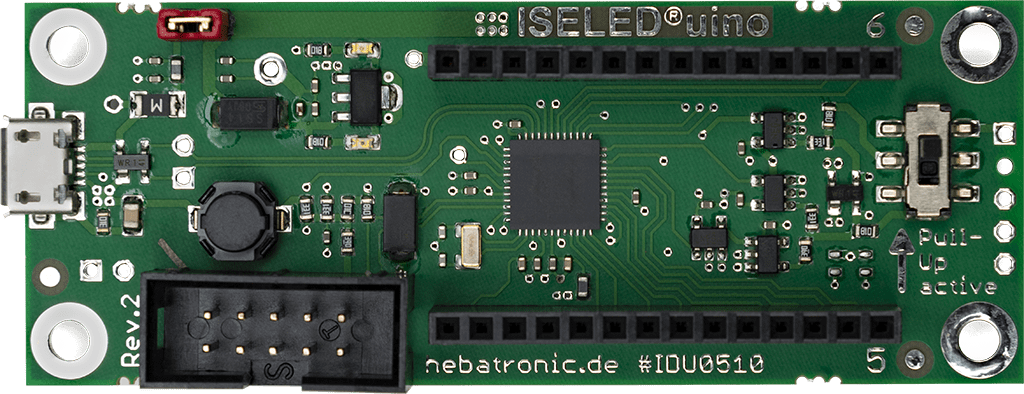
  • Hebatronic Produkte ISELED & ILaS Grafik ISELEDuino
    Hebatronic Product ISELED®uino Arduino MKR Clone Arduino IDE LED Controller

    ISELED®uino

    An Arduino MKR clone for controlling ISELED® equipped with a licensed SAMD21 microcontroller – programmable via USB interface and Arduino IDE.

Frequently Asked Questions

Everything you need to know
about ISELED® and ILaS®

What is the difference between Digital I/O and Modbus TCP for EoL testing with Hebabox / Hebastack ?2026-02-01T15:55:19+01:00

Both Digital I/O and Modbus TCP can be used to integrate Hebabox / Hebastack into an End-of-Line (EoL) test system. The key difference lies in functionality, data depth, and scalability.


Digital I/O (discrete signals)

With Digital I/O, the Hebabox/Hebastack is controlled via simple binary signals (24 V inputs/outputs).

Typical use cases

  • Start / stop a test cycle

  • Reset

  • Output overall status signals such as Busy, OK, or NOK

Characteristics

  • Very simple and robust

  • No Ethernet or network configuration required

  • Limited to ON/OFF signals

  • No parameterization, detailed diagnostics, or measurement data transfer

  • Ethernet hardware is not required

Best suited for

  • Very simple EoL setups

  • Legacy systems

  • Applications with minimal functional requirements


Modbus TCP (Ethernet-based communication)

With Modbus TCP, the Hebabox/Hebastack communicates with the PLC via Ethernet using structured data registers.

Typical use cases

  • Start / stop and full control of test sequences

  • Parameterization (e.g. light values, modes, sequences)

  • Reading detailed status, diagnostics, and error codes

  • Logging and traceability in production systems

Characteristics

  • Significantly higher functional depth

  • Structured data exchange instead of single bits

  • Scalable and future-proof

  • Enables detailed diagnostics and transparency

  • Requires Ethernet connection and PLC-side Modbus implementation

Best suited for

  • Modern EoL production lines

  • Automated test systems with traceability requirements

  • OEM / Tier-1 environments


Which option do we recommend?

While both options are supported, we clearly promote Modbus TCP for EoL testing:

  • Higher functional value

  • More diagnostic and test content

  • Better scalability

  • Preferred and approved interface in BMW production environments

Digital I/O remains an option for minimal setups, but Modbus TCP is the recommended choice for professional, production-grade EoL testing with Hebabox and Hebastack.


Why does Hebatronic not offer LIN-based solutions?2026-01-29T16:00:37+01:00

Hebatronic deliberately does not offer LIN-based solutions because LIN is not technically suited for modern ILaS® / ISELED® lighting systems beyond basic control functions.

LIN was designed as a low-speed control bus for simple actuators and sensors. With a maximum data rate of approximately 20 kbit/s, LIN is well suited for commands such as on/off, dimming, or basic status signals. However, it reaches its technical limits very quickly when used for today’s dynamic, high-resolution LED lighting systems.

Modern ILaS® / ISELED® applications require:

  • High bandwidth for color and brightness data

  • Deterministic timing for synchronized animations

  • Scalability to hundreds or thousands of LEDs

  • Detailed diagnostic feedback at LED level

These requirements are structurally incompatible with LIN. Using LIN as a transport layer for ILaS® functions inevitably leads to compromises in performance, diagnostics, flexibility, and scalability.

Hebatronic therefore focuses on ILaS-native architectures, where lighting data is handled directly on the ILaS® bus and controlled via industrial, deterministic interfaces (e.g. PLC-based systems). This avoids inheriting the technical limitations of LIN and allows the full capabilities of ILaS® to be used without restriction.

In short:

  • LIN is suitable for controlling simple lighting functions.

  • ILaS® is required for driving complex, modern LED lighting systems.

  • Hebatronic designs its solutions around the requirements of ILaS®, not around the limitations of LIN.

This is a conscious architectural decision to ensure long-term scalability, diagnostic depth, and production robustness.


What is the difference between LIN and ILaS®?2026-01-29T14:48:52+01:00

LIN (Local Interconnect Network) and ILaS® (Intelligent Lighting as a Service) are two fundamentally different communication systems used in vehicles, each designed for a specific purpose.

LIN is a classic, low-cost control bus. It was developed for simple actuators and sensors such as switches, motors, and basic lighting functions. LIN operates at a relatively low data rate and is mainly used to transmit control commands like on/off, dimming, or simple status information.

ILaS®, in contrast, is a high-speed bus specifically designed for modern LED lighting systems. It is optimized for ISELED®-based light modules and transmits synchronized color and brightness data to each individual LED in a chain. In addition, ILaS® enables detailed diagnostic feedback from every LED.

In short:

  • LIN is a control bus for simple functions.

  • ILaS® is a data bus for complex, dynamic LED lighting.

Key differences at a glance:

  • Data rate:
    LIN ≈ 20 kbit/s · ILaS® ≈ 2 Mbit/s

  • Typical use:
    LIN → basic control commands
    ILaS® → high-resolution lighting data and animations

  • Scalability:
    LIN → limited number of nodes
    ILaS® → thousands of LEDs in a single chain

  • Diagnostics:
    LIN → basic
    ILaS® → detailed, per-LED diagnostics

In modern vehicle and EOL test architectures, both systems are often used together:
LIN provides the higher-level control or test interface, while ILaS® handles the precise distribution, synchronization, and diagnostics of the lighting system.


Are there additional options or accessories?2025-11-17T13:11:19+01:00

Optionally, the connectors are available with ILaS® measurement cables up to 5 m in length.
They are also offered as accessories for the ILaS® Initiator test systems as well as the Hebastack and Hebabox units – or can be purchased individually as standalone components.

Are the connectors compatible with common systems?2025-11-17T13:08:42+01:00

Yes, the 3D connectors are compatible with standard production sockets, in-vehicle connector systems, and contact pins and test adapters used in the automotive industry.

Which variants are available?2025-11-17T13:07:38+01:00

The series includes:

  • CON8A001A / CON8A001B – 8-pin connectors in black or grey
  • CON4A001A – compact 4-pin connector

All models feature integrated strain relief, cable outlet, as well as coding and locking mechanisms.

Which manufacturing technology is used?2025-11-17T13:03:34+01:00

The connectors are produced using industrial 3D printing technologies (SLS or MJF).
These additive methods offer very high dimensional accuracy, repeatability, and mechanical strength—ideal for frequent mating cycles, precise fits, and customer-specific adaptations.
At the same time, 3D printing enables fast turnaround from prototypes to small series production.

For which applications are the 3D connectors suitable?2025-11-17T13:02:38+01:00

The Hebatronic 3D Connector Series has been specifically designed for development, validation, and testing environments.
Typical use cases include prototype setups, EoL (end-of-line) testers, test systems, and integration environments within the ILaS® and ISELED® ecosystem.
Thanks to their high mechanical stability and customizable geometry, they are suitable for both laboratory applications and series-level use in test systems.

Is the Hebabox/Hebastack suitable for future ISELED® generations?2025-09-25T14:07:40+02:00

Yes, the Hebabox/Hebastack is scalable and future-proof. It comes with the current Hebatronic software and can be flexibly extended for future ISELED® generations.

Can the Hebabox/Hebastack be used in EOL test benches?2026-02-01T16:01:57+01:00

Yes. Hebabox and Hebastack are specifically designed for use in automated End-of-Line (EoL) test systems and are intended for series production environments.

They act as a robust, PLC-integrated gateway between the test system and the ILaS® / ISELED® bus, enabling deterministic and reproducible testing under real production conditions.

Typical EoL test functions include:

  • Deterministic initialization of the ILaS® bus

  • Automatic node detection (node count / presence check)

  • Verification of communication integrity and timing

  • Evaluation of module status and error conditions

  • Functional activation of light modules for GO / NO-GO decisions

Integration into the test system

  • PLC connection via Modbus TCP (recommended for maximum functionality and diagnostics)

  • Alternatively via Digital I/O for simple, minimal EoL setups

  • Clear separation between test logic (PLC) and gateway functionality (Hebabox / Hebastack)

Production and OEM readiness

  • Designed for continuous operation in production lines

  • Scalable to different test depths and requirements

  • Used and approved in OEM and Tier-1 EoL environments (e.g. BMW)

In short:
Hebabox and Hebastack are not laboratory tools — they are production-grade EoL components that integrate seamlessly into modern, PLC-controlled test systems.

In which variants are the Hebabox/Hebastack available?2025-09-25T14:09:46+02:00

In which variants are the Hebabox/Hebastack available?

The Hebabox and Hebastack product family offers flexible gateway solutions for ILaS® and ISELED® systems – from robust devices in IP-protected housings to compact board stacks for direct control cabinet integration.

  • Hebabox: three variants (Connect, Control, Core) for Ethernet connectivity, PLC communication, and manual rework.
  • Hebastack: two variants (Connect, Compact) as space-saving board stacks for industrial automation and PLC control.

This provides a total of five models, suitable for everything from EOL testing and quality assurance to fully automated production – always delivered with the latest Hebatronic software preinstalled and future-proof for upcoming ISELED® generations.

What interfaces does the Hebabox/Hebastack offer?2025-09-25T14:11:49+02:00

In addition to Ethernet (Modbus TCP), the Hebabox/Hebastack features digital inputs and outputs (I/Os) for direct control of assemblies and test systems.

With which PLC systems is the Hebabox/Hebastack compatible?2025-09-25T14:11:13+02:00

The Hebabox/Hebastack supports all common PLC controllers that communicate via Modbus TCP. This makes it flexible for integration into existing automation and production systems.

Does the Arduino FastLED library support the Hebatronic products including the ILaS® – Shield ?2025-09-25T14:11:57+02:00

If you only want to control ISELED®, then you can use the FastLED functions. For ILaS® we currently only have the basic commands like Set_Dimm_Level, and Set_RGB; just like Adafruit’s Neopixel. However, we will provide the FastLED conversion for IlaS® in the future. We also have other solutions for more unusual programming requirements. Please contact us.

What is ILaS®?2024-11-18T17:18:12+01:00

ILaS® is a new fieldbus that can transmit various light sequences at a bus data rate of 2 Mbit/s, enabling video-speed control. ILaS® stands for “ISELED® Light and Sensor” and is currently mainly used in the automotive sector, particularly by BMW in vehicles starting in 2025. With this fieldbus, not only can LEDs be controlled via the ISELED protocol, but sensors and actuators can also be integrated and read in any quantity and combination. With the continuously growing number of LEDs, especially in vehicles, significantly higher data rates for control and diagnostics can be realized.

How is the ILaS®-Initiator test box operated?2024-11-18T17:21:20+01:00

The power supply is provided via an external plug-in power supply 12V/1A, which is included in the delivery.

Is there a manual for the ILaS®-Initiator test box?2025-02-12T11:42:49+01:00

A manual with instructions (Quickstart-Guide) can be downloaded as a PDF file from the IlaS®-Initiator website.

How is the ILaS®-Shield (ILaS®duino) operated?2024-11-18T17:27:14+01:00

The ILaS®duino is powered via USB or 12V. To do this, connect the ISELED®uino pins E_P, E_N, and Gnd to ILAS_H_IN, ILAS_L_IN, GND. The ISELED® lighting modules can be powered with external 12V, but it is essential to connect the GNDs together. On the ISELED®uino, all pins can be used except for A3, A5, and A6. These are the communication pins between the microcontroller and the ILaS®-Shield.

Is the software included in the delivery?2025-03-17T20:12:42+01:00

As a rule, the basic firmware is included. Additionally, an example program is available for download in the Help Center.

Is there documentation for the software?2025-03-17T20:29:02+01:00

The documentation is part of the example program, which is available for download in the help center.

Convinced?

Ready to revolutionize
your lighting systems?

  • Flexible order quantities
  • Made in Germany
  • Worldwide delivery
Go to Top